3.3.4. KAPE Output
3.3.4.1. What is it
KAPE is a DFIR collection tool from Kroll and Eric Zimmerman. You can import its output into Cyber Triage.
You can read more about KAPE and the differences between it and our collection tool on our blog.
Watch the Cyber Triage Basics Course KAPE video on this technique.
Warning
KAPE collections have limitations: KAPE does not collect executable files, which means malware detection will be incomplete or inaccurate, you may see false positives for processes and downloaded files, and analysis of tasks and startup items will be limited. For more complete malware analysis, use the Cyber Triage Collector instead.
Note
Currently Cyber Triage imports only the KAPE .vhd and .zip file contents. It ignores any other KAPE outputs, and will not parse KAPE “Module” output.
3.3.4.2. How to Get The Data
To export data from KAPE for import into Cyber Triage®.
Run KAPE with either the !BasicCollection or !SANS_Triage options selected.

Use either No Container, VHD, or VHDX for the output.
Note
You may see warnings from KAPE, however with these options selected Cyber Triage® should have no issue reading the file.
3.3.4.3. Where To Put Your Data
If you collected as a ZIP file, then you need to manually extract its contents to a folder.
The following locations are supported based on your access method:
Application |
Supported Locations |
|---|---|
Standard |
Locally accessible |
Team, Web Client |
Server Accessible Folder. VHD Only. |
Team, Local Client |
Locally Accessible or Server Accessible Folder |
If you are using the Team with a local client and the data is locally stored, then the client will do the parsing of the KAPE data and send the results to the server. The client must continue to run until the VHD or folder have been parsed.
3.3.4.4. How to Import
To add KAPE data, choose Add New Host from the Incident Overview and choose the KAPE box.
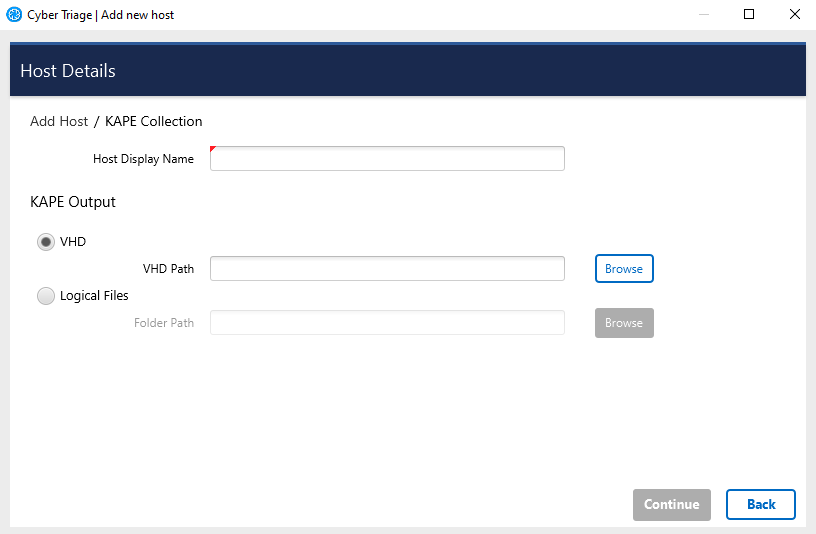
- Choose the Collection Type:
Virtual Hard Disk if your KAPE data is in a VHD or VHDX file
Logical Files if you extracted a ZIP file to a folder (the selected folder must contain a subfolder named either ‘C’ or ‘C%3A’).
Team Only: If you chose “Virtual Hard Disk” and the server has an accessible folder configured, then you’ll be able to choose Location as the server.
Browse to the file or folder.
Update the display name and reference date as needed.
Press Continue to then configure what data types to collect (see Specifying Data Collection Types) and malware settings (see Ingest-Time Settings).